
The best anti-condensation membranes for roofs
Published on 12.08.2026 · Isoflect Insulation technical team
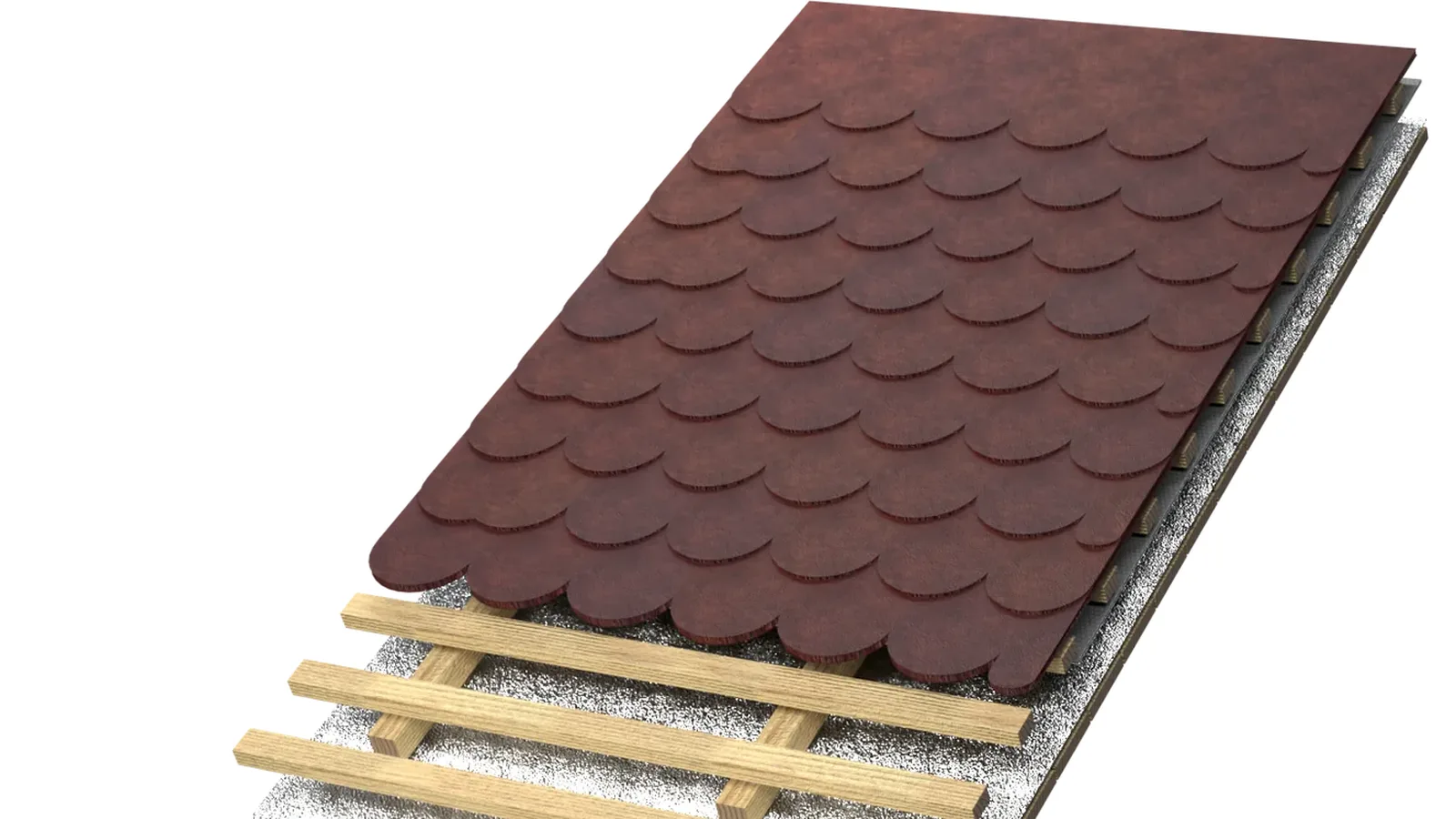
A roof may appear perfect from the outside and nevertheless accumulate moisture in the insulation layer. Stains on the rafters, a persistent smell in the roof space, settled wool or blackened timber often appear when indoor vapour is not correctly controlled. Choosing among the best anti-condensation membranes is not a matter of thickness or price per roll, but of the way in which the membrane works together with the roof covering, the ventilation and the thermal insulation.
For a habitable attic, a cold roof space or a building with a metal roof, the anti-condensation membrane has a precise function: it protects the structure and the thermal insulation from water that may penetrate beneath the roof covering, while allowing indoor vapour to escape to the outside. It is a technical component of the roof system, not merely an additional layer added “just in case”.
What defines the best anti-condensation membranes
In most pitched roofs, a high-performance anti-condensation membrane is a highly vapour-permeable diffusion membrane. It is installed above the thermal insulation, beneath the roof covering, and addresses two different risks: accidental infiltration from outside and condensation formed on the underside of the roof covering.
Liquid water must be conducted safely towards the eaves without reaching the wool or the timber. At the same time, water vapour crossing the assembly from the inside must be able to escape. If this escape is blocked, moisture remains in the structure and reduces the thermal performance of the insulation.
The best membrane is not necessarily the thickest. It is the one with parameters suited to the installation zone and with mechanical strength appropriate to the work. A correctly chosen product provides certain and predictable performance for many years, including when the roof is exposed to wind, large temperature variations and installation work.
Vapour permeability and the Sd value
The Sd value indicates the resistance of a material to the passage of vapour. For a diffusion membrane installed beneath the roof covering, a low Sd value is essential: vapour must be able to migrate towards the outside. In practice, a highly permeable membrane may allow the thermal insulation to be installed in contact with the membrane, provided the roof system is correctly designed.
Do not confuse the anti-condensation membrane with the vapour barrier. The vapour barrier or vapour retarder is installed towards the interior of the heated room, beneath the thermal insulation, and limits the quantity of vapour entering the insulating layer. The anti-condensation membrane is installed towards the exterior. The two products have opposite functions, yet they must work together.
Resistance to water, tearing and UV radiation
A good membrane must be impermeable to water, yet also stable during installation. Resistance to tearing, perforation and nail tear-out is particularly important on steeply pitched roofs, roofs with rafters at greater spacing, or areas exposed to wind.
Also check the UV exposure period permitted by the manufacturer. A membrane should not be left uncovered for longer than the specified interval, even if it appears intact. Solar radiation can gradually degrade the functional layer, and the problems will become visible only after the roof has been closed.
The appropriate membrane depends on the roof covering and on the roof
Beneath ceramic or concrete tiles, a high-performance diffusion membrane is generally the correct solution. It is installed over the rafters, with battens and counter-battens creating the ventilation space required beneath the roof covering. Air must be able to circulate from the eaves to the ridge so that residual moisture can be removed.
Metal-sheet roofs require additional attention. Metal cools and heats rapidly, and condensation on the underside of the sheet may be more frequent. A durable anti-condensation membrane, installed with correct overlaps and with a functional ventilation cavity, limits the risk of droplets reaching the thermal insulation. If the metal sheet has a factory-applied anti-condensation layer, nevertheless check the complete roof detail: that layer does not automatically replace the diffusion membrane, the ventilation or the interior vapour barrier.
In habitable attics, the stakes are higher than in an unheated attic. Cooking, showers, drying laundry and the daily presence of occupants increase indoor humidity. Here, the anti-condensation membrane must be coordinated with the thickness of the thermal insulation, the airtightness of the interior layer and the ventilation of the rooms. An excellent membrane installed in a system that is not airtight on the inside cannot compensate for all the losses of warm, moist air through joints.
Correct installation protects the investment
The anti-condensation membrane is laid with the side indicated by the manufacturer correctly oriented. The rolls are generally installed horizontally, from the eaves towards the ridge, so that water is directed over the overlaps, not beneath them. The details at the ridge, valleys, roof windows, chimneys and penetrations are as important as the large surface of the roof.
For predictable installation, observe a few simple rules:
- respect the minimum overlap specified for the roof pitch;
- seal the relevant joints and perforations with compatible tapes;
- avoid overstretching the membrane, which may promote tearing during expansion;
- create the ventilation space by means of counter-battens;
- lead the membrane correctly to the drainage element at the eaves.
Mistakes that turn the membrane into a weak point
The first mistake is choosing a membrane without checking whether it is a diffusion membrane or a vapour barrier. Installing a vapour barrier beneath the roof covering may prevent the structure from drying towards the exterior. Certain special systems may involve other solutions, but these must be designed as an assembly, not improvised on site.
The second mistake is using a membrane with insufficient strength for the installation conditions. On a roof with complex geometry, many cut-outs and repeated foot traffic by the crew, a fragile membrane can be easily perforated. Every unsealed perforation becomes a potential path for water and air.
Another frequent problem is the absence of ventilation beneath the roof covering. The anti-condensation membrane does not replace the air path between the eaves and the ridge. Without this space, moisture is removed with greater difficulty, and the temperature of the roof covering may rise unnecessarily in summer.
Finally, do not overlook the vapour barrier on the warm side of the building. An exterior anti-condensation membrane cannot stop the uncontrolled flow of moist air from the interior. In a habitable attic, sealing the joints, cable penetrations and connections with the walls is as relevant as the choice of the membrane beneath the roof.
How to choose effectively for your project
Begin with the area of application: cold attic, habitable attic, ventilated roof, metal-sheet roof or renovation over an existing structure. Then check the pitch, the type of roof covering, the spacing between rafters and the manner in which the thermal insulation will be installed. These data determine the level of permeability, the mechanical strength and the sealing accessories required.
For homeowners, a sensible solution is to choose the complete system, not merely the roll of membrane. The membrane, sealing tapes, vapour barrier and thermal insulation must be compatible. In this way, you reduce the risk of gaps, interstitial condensation and heat losses that arise when materials are chosen separately, without a system logic.
At Isoflect, configuring a solution for a habitable attic or an unheated attic starts precisely from these real installation conditions. A technical discussion before ordering can avoid the purchase of a membrane that is too weak, a layer with the wrong function or an insufficient quantity of accessories.
The roof is difficult to open once the work has been completed. It is worth treating the anti-condensation membrane as the active protection of the thermal insulation and of the structure, not as a consumable chosen in haste. With the correct membrane and careful installation, the house remains drier, more efficient and more comfortable in every season.
Not sure which Isoflect product suits you? See Reflectiva Roof Pro or open the package configurator to find out exactly what you need and in what quantity.